Why we built Arcflux: governed AI for the physical world
Workflow builders stop at webhooks and schedules. The machines that run the real world speak MQTT, NATS, and AMQP. Arcflux turns those streams into governed, multi-step AI action — with no bridge service in between.
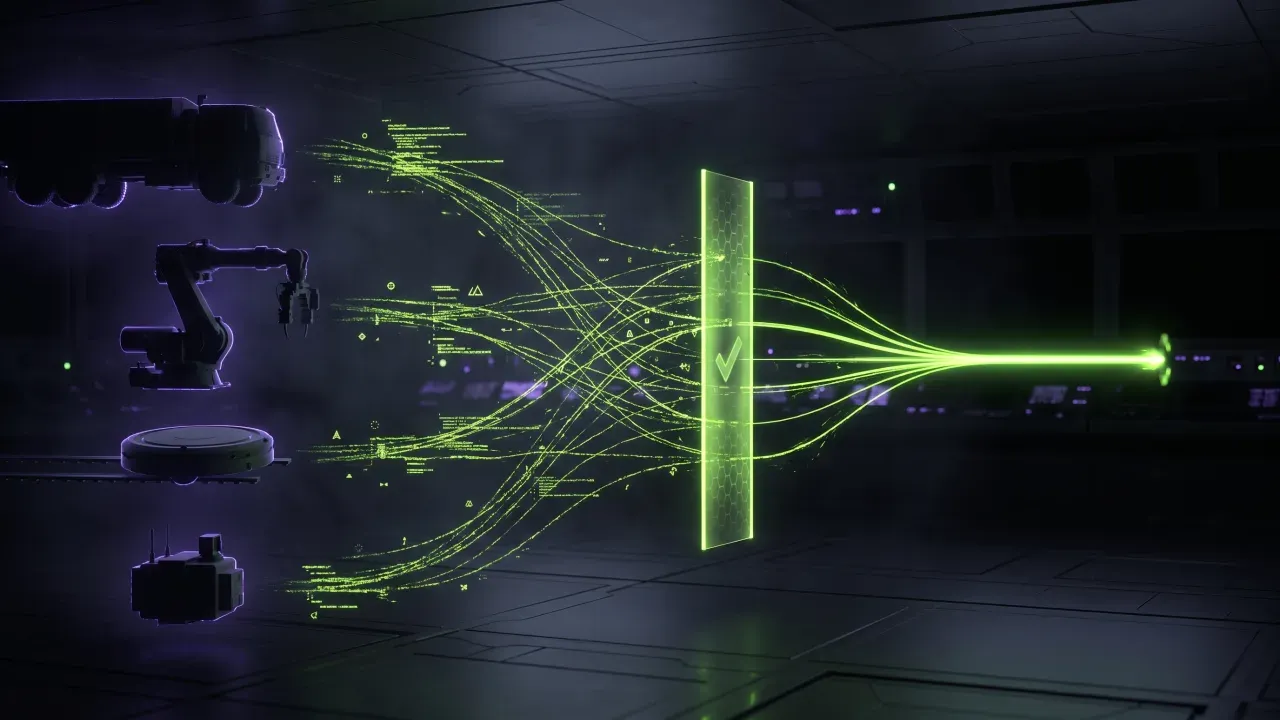
A truck's engine-temperature sensor crosses a threshold. A CNC machine reports a spindle fault. A warehouse robot stops mid-route. Each of these is an event worth acting on — and each one arrives over a protocol that most automation platforms cannot hear.
That gap is why we built Arcflux.
The gap
The current generation of workflow builders is genuinely good at one shape of problem: a webhook fires, a few steps run, something gets written back. That covers a lot of software-to-software automation. But it stops at the edge of the network. The moment the trigger is a sensor, a vehicle, or a machine on a plant floor, you are on your own — standing up a bridge service to subscribe to the broker, normalize the payload, and re-emit it as an HTTP call the builder can accept.
So you write the bridge. Then you operate it: keepalives, reconnects, QoS, back-pressure, an on-call rotation for the day a broker drops and runs silently stall. None of that is the workflow you actually wanted to build. It is plumbing — and it is the reason "connect the AI to the machine" so often dies in a proof of concept.
The wedge
Arcflux speaks the protocols the physical world already runs on. You point a workflow at a broker topic — MQTT, NATS, or AMQP — with wildcards and QoS, the same way you'd add a webhook. No bridge, no glue service to babysit. Every connector reports broker liveness over keepalive, so a dropped device shows up as a health signal instead of a workflow that quietly went dark.
That is the one axis no workflow-builder competitor ingests natively, and it is deliberately the front door of the product rather than a footnote.
Why governance comes first
Connecting to a firehose of device events creates an obvious new problem: cost and noise. A chatty sensor can emit thousands of messages an hour. If every one of those spun up a multi-step AI run, your bill — and your signal-to-noise — would be wrecked in an afternoon.
So governance is not a feature bolted on the side; it sits between the source and the run. Before a single credit is spent, every event passes a policy gate:
- Dedupe — collapse repeats inside a window.
- Cooldown — enforce a minimum interval between runs.
- Throttle — cap the rate.
- Condition — run only when an expression over the payload says so.
- Safety — always-on payload and platform guards.
Events that don't pass are dropped before they cost anything. And because every policy can run in shadow mode first — recording what it would have done without actually blocking — you can tune the gate against real traffic before you let it enforce.
The same gate applies to every source. An MQTT event is governed exactly like a webhook. There is no second-class trigger.
Humans stay in the loop
Speaking to machines also means workflows can act on machines — dispatch a work order, file an incident, actuate something. That is precisely where you want a person. Arcflux workflows pause at approval gates: a run holds, a human sees the full context, and nothing proceeds until someone clicks Approve. Every run is auditable step by step, so "what did the agent do, and why" is never a mystery.
What you build on
Underneath, a workflow is a graph you draw on a canvas in Studio — triggers, agents, tools, branches, and human approvals as nodes, no orchestration code. Switch the model per step without rewriting the flow. Bring any MCP server or native integration; tools are scoped per workflow. Trigger the same workflow from many sources at once — a webhook, a schedule, a chat message, the API, or a live device stream.
Where we are
Arcflux is in alpha. The protocols above are live today; CoAP and MAVLink are on the roadmap. If your events come from the physical world and you want to put a governed agent in front of them, join the waitlist — members get access first.
We think the interesting automation of the next few years doesn't live entirely in the cloud. It starts at a sensor. We built Arcflux to meet it there.