The Next Evolution of Arcflux
Why we're taking Arcflux Alpha offline and rebuilding around a sharper problem: an AI decision system for real-world operations.
The Next Evolution of Arcflux
Arcflux Alpha did not become the release we intended. But it gave us something more valuable than the appearance of momentum: clarity about what deserves to be built next.
We are taking the current production environment offline while we develop Arcflux V2. This is not the end of Arcflux. It is a deliberate step back from operating a product that is no longer aligned with where the opportunity — and the real customer problem — has led us.
What V1 taught us
The first version of Arcflux began as a general AI workflow-orchestration platform. It allowed people to connect triggers, AI models, knowledge, tools, logic, guardrails, and human approvals in a visual workflow.
Underneath that interface, we built much of the foundation needed for a serious orchestration system: versioned workflows, event triggers, policy checks, long-running execution, integrations, usage controls, and the ability to coordinate AI with conventional software.
Technically, it proved that the foundation could work.
What it did not prove was why a specific customer urgently needed it.
That distinction matters. A flexible platform can demonstrate many impressive possibilities while still asking the customer to identify the problem, design the solution, and justify the adoption. We were leading too often with what Arcflux could do rather than with an operational problem it could solve better than existing workflow and automation tools.
Adding more nodes, models, or integrations would not have answered that question. The next step was not simply to build a larger workflow builder. It was to become much more precise about the decision Arcflux helps someone make, the action it helps them take, and the measurable result that follows.
The problem we are moving toward
Real-world operations already produce a constant stream of signals.
A camera detects an anomaly. A sensor crosses a threshold. A machine changes state. A drone identifies a possible inspection issue. A work order becomes overdue. An operator reports something that does not match the system of record.
The problem is rarely a complete absence of data. The problem is that the signals arrive through disconnected systems, without enough operational context, and at a volume that makes consistent human response difficult.
Teams still have to determine:
- What actually happened?
- Which asset, site, order, or customer is affected?
- Is this signal important, or is it noise?
- What should happen next?
- Who is responsible?
- Does a person need to approve the action?
- Was the issue ultimately resolved?
This is the gap Arcflux V2 is being designed to address.
From workflow builder to AI decision system
The long-term goal of Arcflux is to become an AI decision system for real-world operations: a layer that connects live operational signals with context, governed decisions, and coordinated action.
The workflow engine remains important, but it moves behind the customer problem. Customers should not have to begin with a blank canvas and ask, "What can I automate?" They should be able to begin with a concrete operational outcome, such as reducing response time to equipment anomalies, triaging inspection findings, or coordinating an incident across people and systems.
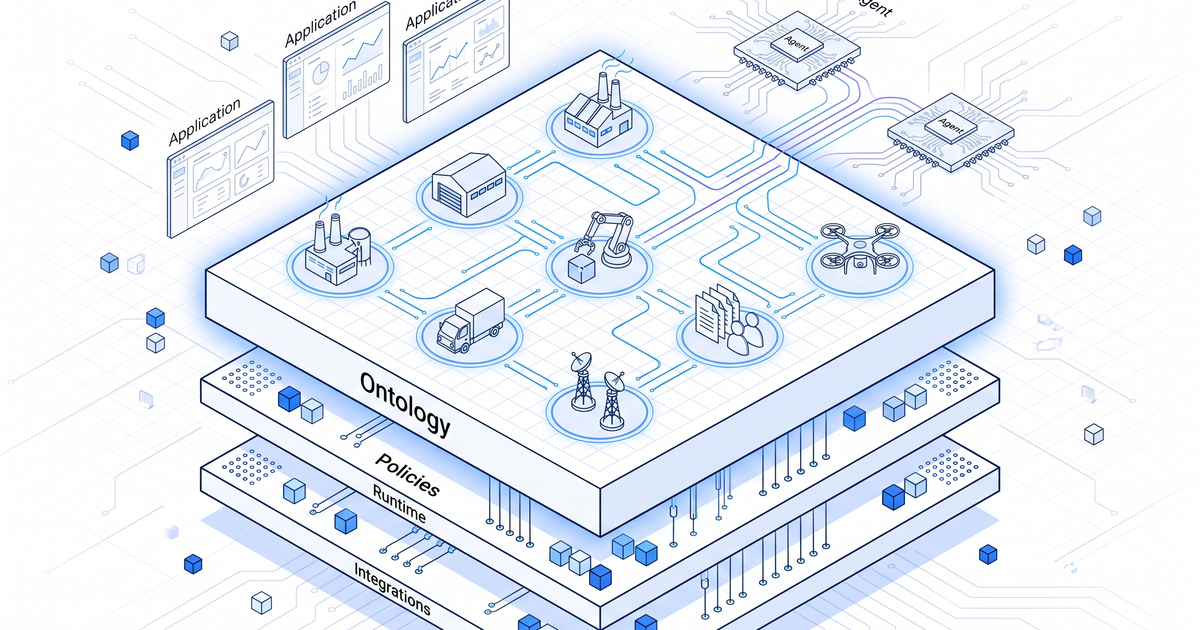
Arcflux V2 is being shaped around a continuous operational loop:
- Observe — receive events from cameras, sensors, machines, edge systems, business software, and human input.
- Understand — filter noise, apply policy, and connect each event to the relevant operational context.
- Decide — combine deterministic rules, AI reasoning, historical knowledge, and human judgment to determine the next step.
- Act — coordinate people, software, and approved device actions through a governed workflow.
- Learn — record the outcome so future decisions have better context and can be evaluated.
This is more than moving data from one application to another. It is about maintaining a shared picture of what is happening, why it matters, what has already been attempted, and what should happen next.
A living model of operations
A major part of V2 will be an operational model that connects the things a business cares about: sites, assets, devices, events, work orders, procedures, teams, and outcomes.
This model gives AI something more reliable than an isolated prompt or a raw stream of telemetry. It allows a decision to be grounded in relationships and current state.
For example, a high-temperature event means very little on its own. Its meaning changes when the system knows which machine produced it, the machine's normal range, its maintenance history, whether production is currently running, what other sensors are reporting, and which procedure applies at that site.
The aim is not to let an AI model make unconstrained decisions about physical operations. Safety-critical and hard real-time control belongs in the deterministic systems designed for it. Arcflux is intended to operate above that layer: interpreting events, coordinating response, enforcing approvals and policies, and preserving a traceable record of why an action was recommended or taken.
Where we are starting
We are beginning our discovery in industrial and asset-heavy operations, including environments such as manufacturing, warehouses, logistics, infrastructure, inspection, and field operations.
These environments make the problem especially visible: many heterogeneous devices and systems, high volumes of events, fragmented operational knowledge, and costly delays between detection and response.
We are not claiming that we already know the final vertical or winning use case. V2 will be developed around specific operational pain points and validated with the people who experience them. The product will become narrower before it becomes broader.
Our near-term focus is to find situations where Arcflux can demonstrate a clear advantage through outcomes such as:
- faster signal-to-decision and signal-to-action time;
- fewer missed or incorrectly prioritized events;
- less manual investigation across disconnected systems;
- more consistent execution of operational procedures; and
- a complete, explainable history of decisions and outcomes.
Why we are taking Alpha offline
Keeping the existing Alpha running would divide attention between maintaining yesterday's product and discovering tomorrow's one. It would also create the impression that the current interface represents the destination, when it is now only one part of the foundation.
Taking it offline gives us room to simplify the architecture, reconsider the product experience, and concentrate resources on customer discovery and the first V2 use cases.
The lessons and engineering from V1 are not being discarded. The event-policy layer, orchestration runtime, workflow concepts, integrations, guardrails, and human-approval patterns all inform the next system. What changes is the center of gravity: from offering general-purpose AI automation to solving a defined operational decision problem.
What comes next
The next phase of Arcflux will be quieter and more focused. We will spend less time demonstrating how many things the platform can connect and more time proving that it can improve a real operational outcome.
We will share what we learn as V2 develops, including the architecture, design choices, prototypes, and — most importantly — the problems that survive contact with real users.
If you operate a facility, warehouse, logistics network, inspection process, or other asset-heavy environment — and your team struggles with alert noise, disconnected operational data, manual triage, or slow coordination — we would like to learn from you. Reach us at info@arcflux.ai.
Arcflux is evolving, but the underlying belief remains the same: AI becomes most valuable when it can understand what is happening in the real world and help people take the right action at the right time.
That is what we are building toward next.